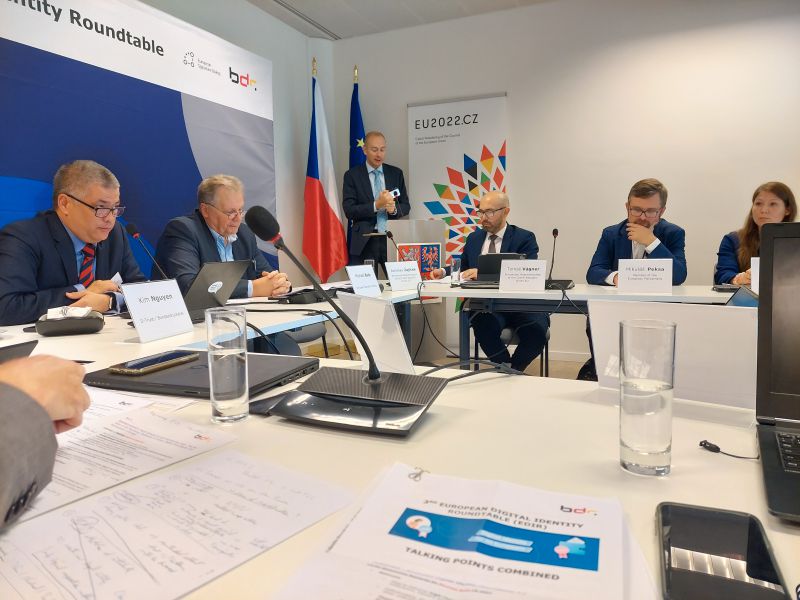
v.l.n.r: Kim Nguyen, Michael Butz, Jaroslav Zajíček, Tomáš Vágner, Mikuláš Peksa, Mirja Rasmusson; Copyright BDR
The 3rd European Digital Identity Roundtable, under the auspices of the Czech EU Council Presidency, brought together representatives of the European Parliament, Member States and industry. Discussion on the browser visualisation of qualified website certificates is still ongoing. An additional focus was on the practical implementation of the European Digital Identity Wallet. The importance of national identities as anchor identities was a further topic of discussion.
Brussels, 28 September 2022 – As organisers of the 3rd Digital Identity Roundtable, the European Signature Dialog and the Bundesdruckerei Group brought together representatives from the European Parliament and Member States along with providers and users of digital identities to discuss the current legislative development of the European Commission’s proposal for a European Digital Identity Framework. This year’s event took place under the auspices of the Czech EU Council Presidency.
This roundtable focused on the current central issues of the legislative process, with the shadow rapporteur MEP Mikulás Peksa and Tomáš Vágner of the relevant Council Working Group outlining the status quo. The exchange on more controversial aspects of the dossier centred around the visualisation of what are termed Qualified Web Authentication Certificates (QWACs), which create transparency and confirm and provide the website provider’s secured identity for the user. “The visualisation of QWACs helps consumers to navigate securely through the digital world,” stressed Dr Kim Nguyen, Managing Director of D-Trust GmbH, a company of the Bundesdruckerei Group. “The EU should make use of its right to set standards in this respect and strengthen EU sovereignty in the interest of European consumers and industry. We hope that critical voices in the European Parliament recognise this as well.”
The event additionally focused on the practical implementation of the European Digital Identity Wallet. Regulatory and technical challenges at the European level were discussed, with the participants agreeing that much can be learned from national pilot projects. Special attention was paid to potential use cases: “The provision of a secure and user-friendly digital identity derived from a national eID as an anchor identity is the precondition for a trustworthy Digital Identity Wallet which can enable attractive and accessible use cases that will be central to the success of the project,” outlined Michael Butz, Chairman of the European Signature Dialog. “To build this ecosystem,” he continued, “various actors need to work together. By organising this roundtable, the European Signature Dialog and Bundesdruckerei have once again contributed to this goal.”
The participants welcomed the opportunity to discuss their views on the European Commission’s proposal for a European Digital Identity Framework and agreed on the necessity to reach compromises in the interest of citizens, including controversial aspects of such a framework.
The EDIR was launched in 2020 by the European Signature Dialog (ESD), a platform of leading European providers of electronic signatures, and Bundesdruckerei, the IT security company of the German Federal 2 Government. The event series is a forum for relevant stakeholders and seeks to foster an open exchange on existing initiatives, experiences and best practices to support European institutions and the EU Member States in their efforts to create an EU-wide digital identity scheme.
About ESD: ESD aims to connect major European Trust Service Providers to share best practices, develop a common industry viewpoint on regulatory issues and empower European solutions for guaranteed data-security. Together with their partners ESD enables large numbers of secure authentication as well as trusted digital identities across the entire continent on a daily basis – for people, for businesses, for public entities. Closely interacting with EU authorities, ESD is building a an important bridge between eIDAS regulation and its harmonized implementation on national levels – thereby driving an efficient cross- European eIDAS implementation framework. In the presence of EU Commissioner Andrus Ansip, the first European signature dialog took place in Vienna, June 2017.
Read More
Brussels, 28 September 2022
Leave a Reply